













A Level
UCAS Tariff Table 2026: How Many UCAS Points Do I Have?

Last Reviewed: 28 April 2026 - 2 min read
Exam results day is coming up fast… and if you're like most students, you've got UCAS Track on constant refresh, anxiously checking for updates on your university offers.
Suddenly, you see UCAS Tariff points mentioned in one of your choices – what are they, and how do you calculate them?
No need to stress! We’re here to break it down for you.
What is the UCAS Tariff?

The UCAS Tariff is a points-based system that assigns a numerical value to post-16 qualifications in the UK, like A Levels and Scottish Highers. This system helps universities compare different qualifications more easily.
Each grade is worth a specific number of points, with higher grades earning more points – so the better your results, the higher your UCAS points total.
Want to know how your grades translate into UCAS points? Stay tuned for our quick and easy guide to calculating them.
Why do UCAS Tariff points matter?
UCAS Tariff points help universities track admissions data, but some institutions also use them as part of their entry requirements – meaning they may offer you a place based on your total points rather than specific grades.
This can actually work in your favour!
For example, if a university requires two As and a B, missing those grades could mean losing your offer. But if they ask for 120 UCAS points instead, you have more flexibility—you could reach that total with two Bs and two Cs instead.
So, if your results don’t go exactly as planned, UCAS points could still help you secure your place!
How many UCAS points do I have?
Need to calculate your points? Check out our UCAS Tariff table below and add up your total – and if you’re taking an A Level Double Award, just double the points for that grade!
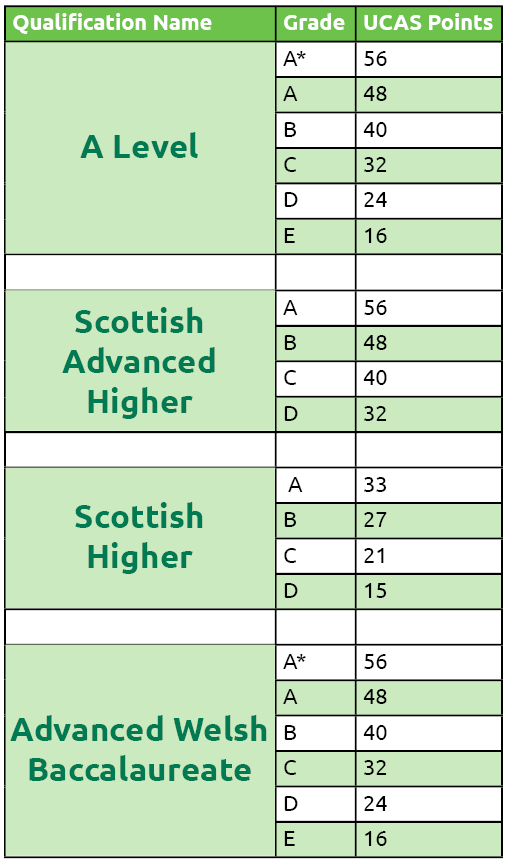
How to Maximise Your UCAS Tariff Points
If you're looking to boost your UCAS Tariff points, there are a few ways to give yourself an advantage:
- An Extended Project Qualification (EPQ): Many universities value an EPQ because it helps develop research and independent study skills – plus, it’s worth up to 28 extra UCAS points!
- Additional Level 3 Qualifications: Core Maths and other Level 3 courses like BTECs or Cambridge Technicals can add to your total, depending on your university’s entry requirements.
- Alternative Subjects: Some universities award different UCAS points based on the combination of A Levels you take, so it's worth checking if your chosen uni favours certain subjects.
How UCAS Points Relate to Different University Offers
Not all university offers are the same – some focus on grades, while others are all about Tariff points. For example:
- University A might ask for ABB in A Levels, meaning you must meet those exact grades.
- University B might require 120 UCAS points, meaning you can mix and match your grades to meet the total.
The benefit? A points-based offer gives you more flexibility. So, if you get BBB instead of ABB, you could still meet the entry requirements. Be sure to check your university’s admissions policy to understand exactly what they’re looking for.
UCAS Points for International Students
If you're an international student planning to study in the UK, you may be wondering how your qualifications compare.
- UCAS provides an international qualification guide, showing how different grades translate into UCAS Tariff points.
- Universities might accept your grades directly, rather than converting them to Tariff points, so check their entry requirements.
- If your qualifications don’t quite match, you may need to take a Foundation Year or additional courses to meet the requirements.
Unsure how your qualifications compare? Contact UCAS or your chosen university for clarification.
UCAS Clearing and Adjustment: What Are Your Options?
If you didn’t quite meet your offer, don’t panic! Clearing is your chance to find another university place. Here’s what you need to know:
- Clearing: If you didn’t get the required grades or points, Clearing lets you apply for courses with available spaces. Many top universities still have places up for grabs!
- Adjustment: If you did better than expected, you could switch to a higher-entry course or a different university through Adjustment.
Whether you're rethinking your choices or looking for new opportunities, there’s always a way forward.
Need to work out your UCAS points fast? Use the official UCAS Tariff Points Calculator to add up your qualifications and see where you stand.
To Sum It All Up:
- Not all universities use Tariff points! Some base offers on grades instead.
- Not all qualifications have Tariff points, but they may still be accepted.
- Only your highest qualification level counts – A Level points replace AS Level points.
- Universities use Tariff points differently, some require specific grades, while others accept a total points score. Always check your offer carefully!
- If you're unsure about entry requirements, contact the university for clarification.
For a full list of UCAS Tariff points, visit the UCAS website.
Resit Your A Levels Online
If your results weren’t what you hoped for, don’t worry – resitting your A Levels online could be the key to securing your university place!
With flexible online learning, unlimited tutor support, and the freedom to study at your own pace, you can retake your A Level exams and get the grades you need to move forward with confidence.
Enrol on a 100% online A Level qualification with ICS Learn today!
Download Your Free A Level Course Guide
Get information on our A Level courses
Share this post

How to Use AI for Maths Homework: A Practical Guide

04 May 2026 - 3 min read

A Second Chance at Learning: Lewis Edon’s Journey

22 April 2026 - 3 min read

A Level Student Stories: Abbie Nugent | A Level Law
10 November 2025 - 2 min read
